The lack of dynamic monitoring of protein structural changes
Proteins are complex biopolymers that form the fundamental building blocks of life. The structure of proteins is crucial in determining how they behave, and this structure can change under different conditions; e.g. proteins may incorrectly fold during the expression process, or denature in response to changes in temperature, pH, etc. These deviations lead to loss of function, loss of therapeutic effectiveness, increased immunogenicity or reduced product shelf life. Hence, medicine and pharmaceutical industries have an unmet need for dynamic, in-situ monitoring of proteins, for quality control and accelerated drug discovery.
PROTEMIC brings together the disciplines of Physics, Analytical Chemistry and Biotechnology to address this critical issue. The protein structure will be determined using the sample’s mid-infrared absorption spectrum without the use of labels or reagents, building on recent technological breakthroughs and the consortium’s wealth of experience.
The network combines photonic integration and advanced spectroscopy to demonstrate a new paradigm of in-situ measurements of protein denaturation, by embedding the photonic chip into the reaction vessel. It will enable the mapping of structural changes during dynamic reactions in realtime, improving the manufacturing efficiency of protein-based pharmaceuticals and allowing scalable screening of proteins for drug discovery.
ADVANCED SPECTROSCOPY SYSTEMS
Going beyond the limits of established absorption spectroscopy, PROTEMIC will investigate novel technologies such as integrated photothermal spectroscopy, on-chip dispersion spectroscopy and imaging techniques such as AFM-IR and Fluorescence-Photothermal Induced Resonance.
PROTEIN ENCAPSULATION
Encapsulation is a process in which tiny droplets are surrounded by a coating to give small capsules, and provide for the controlled release of the contents (e.g. a vaccine). PROTEMIC will seek to vastly improve the options to study encapsulation in real time, improving the understanding of the release process.
INTERBAND CASCADE DEVICES
PROTEMIC will expand the accessible wavelength range of Interband Cascade Lasers far beyond 6 µm at room temperature, and explore the platform’s use as mid-IR detectors. The performance of External Cavity Quantum Cascade Lasers will be improved for wavelength tuning applications.
PROTEIN QUALITY CONTROL
The protein content of human milk, in particular Extracellular Vesicles (EVs), is important for promoting infant growth. PROTEMIC will develop a compact prototype to enable fast and direct quantification of diet-related parameters in HM samples at point-of-care, and a novel analyzer for EVs.
PHOTONICS INTEGRATION
The on-chip integration of photonics capabilities will be employed to add in-situ functionality to microtitre plates. Photonics packaging and Photonic Integrated Circuits (PICs) will be used to implement pluggable optical interconnects for disposable reaction vessels.
WORK PACKAGES
WORK PACKAGE 1
Integrated Spectroscopy for
Protein-Assisted Drug Discovery & Delivery
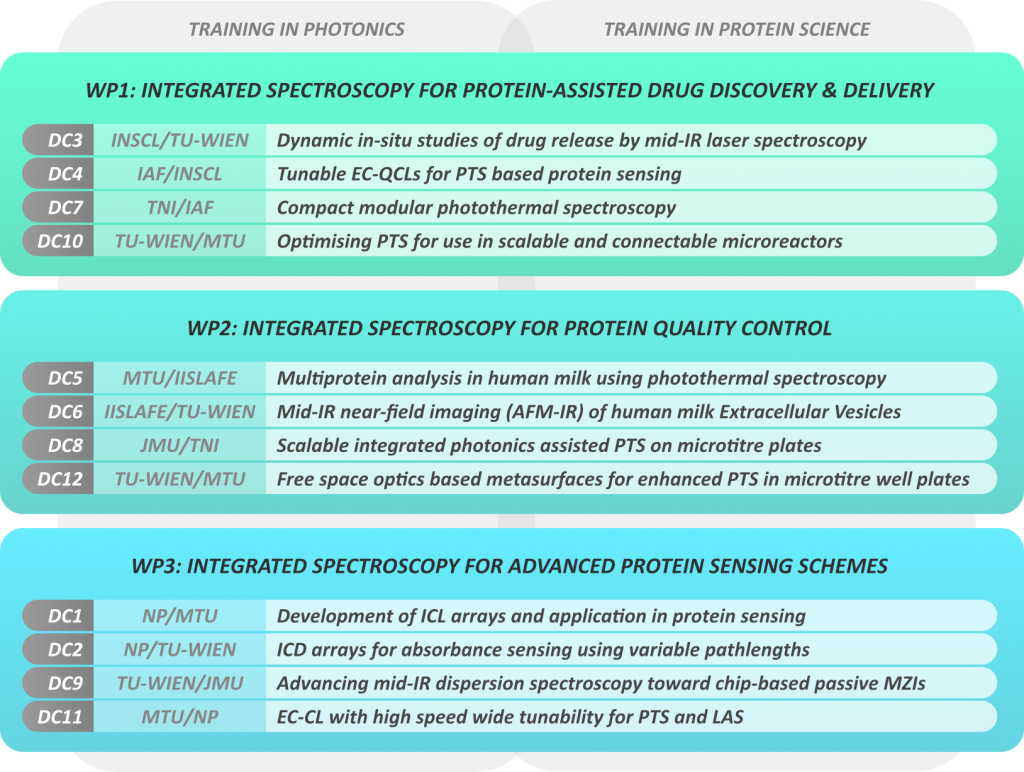
WP1 is dedicated to developing an innovative on-chip Mid-IR photonics device and generating data analysis algorithms for drug release kinetics, towards comprehending protein-based drug delivery dynamics.
InsuCaps leads WP1, their expertise in protein encapsulation and delivery forms the backbone of the work package. TU-WIEN and MTU lead critical tasks related to instrument development and successful monitoring of the drug release process and data analysis.
Task 1.1 [Lead: InsuCaps]: Understanding protein denaturation and protein-based encapsulation methods This task centres on gaining a comprehensive understanding of industrial protein-based encapsulation methods, protein denaturation, and the dynamic changes that occur during drug delivery. PhD candidates will delve into the factors contributing to protein denaturation, including environmental conditions and formulation. The insights gained will provide a foundation for the development of advanced drug delivery systems.
Task 1.2 [Lead: TU-WIEN]: Spectroscopy for understanding protein denaturation and temporal resolution of dynamic changes Task 1.2 aims to develop an on-chip metasurface-based mid-IR photonics device for monitoring protein structure dynamics. Candidates will design and fabricate this innovative device to provide high-resolution spectroscopy, enabling a deep understanding of protein kinetics during denaturation. This task bridges photonics and molecular biology, advancing drug discovery and delivery systems in WP1.
Task 1.3 [Lead: MTU]: Data analysis and algorithms for protein denaturation kinetics Task 1.3 is dedicated to the systematic analysis of data obtained from spectroscopic monitoring of protein denaturation and drug release processes. Candidates will employ advanced data analysis techniques to extract meaningful insights from the complex spectroscopic data sets. These algorithms will enable the quantification of key parameters governing the release processes, such as release rates, reaction kinetics, and stability profiles.
WORK PACKAGE 2
Integrated Spectroscopy for
Protein Quality Control
WP2 aims to develop real-time monitoring of protein structural changes during downstream processing and analysing the structural changes observed in donated human milk to enhance infant nutrition.
This WP is led by IISLAFE and involves partners MTU (human milk testing prototype assembling), IISLAFE (prototype benchmarking; collection of HM samples), TU-WIEN (balanced detection), and IAF (EC-QCL source).
Task 2.1 [Lead: TU-WIEN]: Integrated photonics PTS system for real-time monitoring of structural integrity during manufacturing and quality control This task focuses on developing an integrated photonics-based mid-IR and photothermal spectroscopy hardware, capable of monitoring proteins for subtle changes in their secondary structure, primarily for downstream processing chromatography columns.
Task 2.2 [Lead: IISLAFE]: Advanced spectroscopic monitoring for downstream processing of industrial proteins and quality control of human milk proteins This involves the testing of human milk samples using the developed prototypes for the rapid and direct quantification of the three main proteins in human milk: casein, α-lactalbumin, and lactoferrin. The prototype, equipped with an EC-QCL source, will operate in the flow-through mode and be evaluated against difference absorbance spectroscopy using a balanced detector. Clinical benchmarking will be conducted by analysing human milk samples across different postnatal and gestational ages.
WORK PACKAGE 3
Integrated Spectroscopy for
Advanced Protein Sensing Schemes
WP3 aims to develop novel sensing schemes for in-situ reaction monitoring. The combination of the developed active and passive building blocks including packaging will produce competitive analysis systems.
WP3 is led by TU-WIEN, and will provide designs & test platforms for use by the DCs.
Task 3.1 [Lead: MTU]: PIC-assisted Photothermal Spectroscopy This task will include systematic studies on the time resolved effects in photothermal spectroscopy including photoacoustic (ns – μs time scale) using dedicated sources (EC-QCL). Based on the gained understanding, an optimal sensing configuration based on integrated and fibre coupled PICs for monitoring of a reaction vessel (SpectroModule) as well free-space coupled sensing PICs for monitoring the wells of a 96-well plate (SpectroPlate) will be realized. Increased wavelength coverage and rapid tuning through metalenses will amplify the possibilities of PTS. Metasurfaces will also support efficient focussing and lead to relaxed alignment requirements in the assembled systems.
Task 3.2 [Lead: TU-WIEN]: Multi-pathlength Waveguides and Dispersion Spectroscopy Planar Mid-IR waveguides offer an additional degree of freedom for evanescent wave spectroscopy. Coupled to ICD arrays multi-waveguide sensors will be realized first. This work shall lead to passive 3*3 chip-integrated Mach Zehnder Interferometers employing waveguide structures. Chips will be created for absorption spectroscopy versions of SpectroModule and SpectroPlate.
Task 3.3 [Lead: TU-WIEN]: AFM-IR Imaging AFM-IR will allow for label-free imaging with 10 ns resolution, whereas F-PTIR achieves contactless readout of temperature modulated fluorescence. Metasurfaces and dedicated pulsed sources will allow improvements in terms of speed and sensitivity for both modalities leading, enabling also the study of dynamic samples.